High Power LED & Laser LED
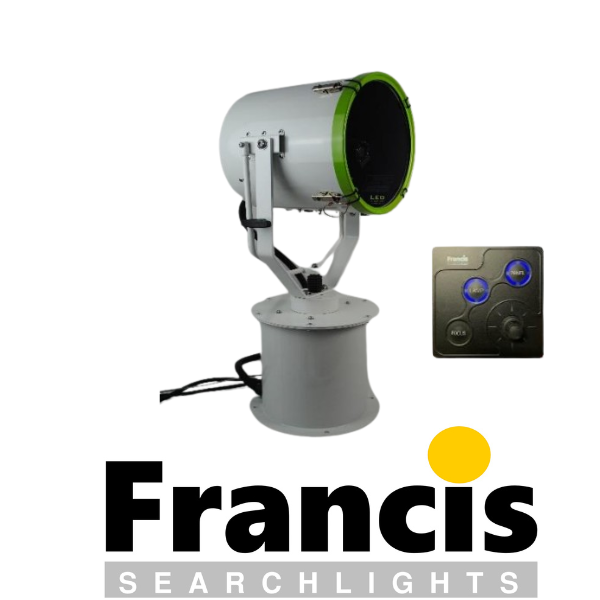
Modern manual and remote controlled searchlights, including long range 250W and 500W Laser LED models.

MARINE SEARCHLIGHTS · SIGNALLING · CONTROLS · SPARE PARTS
MariTeam supplies Francis marine searchlights, signalling lanterns and spare parts for commercial vessels, workboats, patrol craft, offshore vessels and specialist marine applications. Compare technologies, identify the correct model from objective operating requirements, or search by Francis model and part number.
SELECT BY PERFORMANCE
A marine searchlight should be selected from the job it must perform. The most useful comparison is the documented illumination range together with beam divergence, focus, control method, supply voltage, mounting arrangement and environmental requirements.
ABOUT FRANCIS
Francis Searchlights Limited has designed and manufactured specialist lighting products since 1901. The current marine programme spans compact signalling lights, conventional halogen and xenon searchlights, modern LED and Laser LED systems, Voyager units and specialist Suez Canal solutions.
PRODUCT FAMILIES
Modern manual and remote controlled searchlights, including long range 250W and 500W Laser LED models.
Low profile remote controlled searchlights for yachts, high speed craft and patrol vessels.
Traditional halogen searchlights covering a broad range of barrel sizes and power ratings.
High intensity professional searchlights for applications where beam reach is critical.
High output systems plus dedicated Suez Canal searchlight configurations.
FSP handheld lanterns and signalling projectors for professional visual communication at sea.
SEARCHLIGHT SELECTOR
Start with the type of equipment you need. Then narrow the result by required range, technology and control. No product list is shown until you have made a meaningful selection.
Compact solution for smaller craft.
View modelCompact LED searchlight for smaller craft and vehicles.
View modelCompact deck or cabin searchlight for smaller vessels.
View modelFixed focus LED searchlight with a wider beam.
View modelCompact high performance LED searchlight.
View modelLow profile remote controlled searchlight for patrol and smaller craft.
View modelAdjustable focus manual LED searchlight.
View modelVariable speed remote control with adjustable focus.
View modelTwinhead LED configuration with remote control features.
View modelHigh output manual LED searchlight with remote focus.
View modelHigh output remote controlled LED searchlight.
View modelSearchlight and thermal imaging in one remote controlled system.
View modelRemote controlled Explorer Azimuth configuration.
View modelHigh output twinhead system with variable speed remote control.
View modelTwinhead LED searchlight with integrated thermal imaging.
View modelHigh power remote control searchlight with FBUS and remote focus.
View modelBroad high output beam for demanding marine installations.
View modelHigh output manually controlled LED searchlight with adjustable focus.
View modelRemote controlled LED searchlight with adjustable focus.
View modelVery long range manual searchlight with narrow and wide beam.
View modelVery long range Laser LED with variable speed pan and tilt.
View modelExtreme long range performance with manual configurations.
View modelExtreme long range remote control searchlight.
View modelCompact traditional halogen searchlight family.
View modelCompact remotely operated Halogen Lite family.
View modelBroad power range for professional manual installations.
View modelRemote control Halogen Lite searchlight family.
View modelHigh output twin head Halogen Lite system.
View model380 mm traditional halogen platform.
View model380 mm remote controlled Halogen Lite platform.
View modelCompact handheld marine signalling lantern.
View modelMED / SOLAS daylight signalling lantern.
View modelHeavy duty signalling projector for medium and large vessels.
View modelPermanent visual signalling and searchlight solution.
View modelRemote controlled signalling searchlight.
View modelLED signalling searchlight with lock-open searchlight function.
View modelRemote LED signalling searchlight with variable speed control.
View modelLarge professional signalling projector for long range communication.
View modelLow profile Voyager searchlight for yachts and patrol craft.
View modelLow profile LED Voyager for yachts and fast craft.
View modelHigh intensity xenon Voyager family.
View modelHigh intensity Voyager with adjustable focus.
View modelPortable specialist Suez Canal searchlight with lamp changeover.
View modelLarge Suez Canal searchlight with single or split beam configuration.
View modelSPECIALIST APPLICATIONS
These Francis ranges are grouped by application: signalling, low profile Voyager searchlights and dedicated Suez Canal solutions.
FSP68, FSP127, FSP250, FSP300, FSP300RC and FSP380 cover handheld and permanently installed marine signalling requirements.
View signalling products →VH500 Halogen, VL500 V2 LED, VX500 Xenon and VM500RC EmArc provide low profile remote controlled solutions for yachts and fast craft.
View Voyager LED model →LSP380 portable metal halide and FL710 halogen searchlights are available for specialist Suez Canal applications.
View LSP380 →Francis Searchlight Spare Parts
MariTeam's Francis Spare Parts Finder lets you search verified Francis references, lamps and compatible models, combine several items in one RFQ, and upload your own nameplate photos, manual pages, drawings or parts lists for identification.
The interactive finder loads automatically in your browser. If it does not load, you can still send your Francis model, product number, serial number, part numbers and documents to sales@mariteam.dk.
TECHNICAL GUIDANCE
Searchlight performance, light source, installation and statutory requirements are different questions. Use this guidance to compare products on the right basis and identify the information needed for a correct specification.
Lumens describe total light output, candela directional intensity and lux the light reaching a surface. For searchlights, compare range at the same lux level and always consider beam angle.
LED suits efficient low-maintenance operation, Laser LED extreme range, halogen simple serviceability, while xenon, metal halide, EmArc and CSI remain relevant for high-intensity or specialist applications.
Francis solutions include deck and cabin manual control, pedestal mounting, remote control, low-profile Voyager units, twinhead systems, azimuth indication and thermal camera integration.
Lumens measure the total visible light emitted by a source. Candela measures luminous intensity in a particular direction and is therefore important for concentrated searchlight beams. Lux measures illuminance at the target surface: one lux is one lumen per square metre. A searchlight can have fewer lumens than another product and still achieve a longer range if its optics concentrate the light more effectively.
It is the distance at which the manufacturer specifies that the beam still produces approximately 1 lux on the target. It is a useful comparison value only when products are compared at the same lux reference and under comparable test conditions.
Not directly. A 2 lux figure uses a higher required illuminance at the target and is therefore a stricter reference. Always compare searchlights using the same lux basis, and check the beam divergence and test conditions as well.
A narrow beam concentrates the available light into a smaller area and normally gives greater reach. A wider beam illuminates more area but usually at a shorter range. Adjustable or remote focus is useful when the same searchlight must switch between long-range spotting and wider-area illumination.
There is no single best source. LED offers long life, instant start, high efficiency and low maintenance. Laser LED is suited to very long-range work with a highly concentrated beam. Halogen remains simple to service and uses replaceable lamps. Xenon provides very high directional intensity but needs dedicated high-voltage control gear. Metal halide, EmArc and CSI are specialist high-intensity sources used where their particular optical performance is required.
Choose LED for most general marine searchlight duties where efficiency, lifetime, low maintenance and a useful adjustable beam are priorities. Choose Laser LED when very long range is the main requirement and a narrow high-intensity beam is operationally useful. Final selection should also consider control method, installation height, beam spread and the environment in which the light will be used.
Manual units are positioned locally by deck or cabin controls and are often mechanically simple. Remote control models use an electric pan-and-tilt mechanism operated from the bridge, normally with a joystick or control panel. Remote systems can add variable speed, auto-home, remote focus, azimuth indication, master/slave panels or integration with other bridge systems.
Deck control means the operator handles the searchlight locally on deck. Cabin control uses a mechanical arrangement that allows the searchlight to be aimed from a protected position below or behind the mounting surface. Pedestal mounting raises the searchlight above the deck or structure and can provide the required operating height and clearance. The correct arrangement depends on vessel layout, access, visibility and structural support.
Confirm supply voltage and available power, mounting footprint and structural support, cable routes, control panel location, pan-and-tilt clearance, beam obstruction, deck penetration and sealing, ingress protection, ambient temperature, service access and any hazardous-area requirements. Remote installations should also confirm the control architecture and communication cabling.
Twinhead systems increase total light output and can provide broader or redundant illumination. Azimuth indication shows the direction in which the searchlight is pointing, which is useful on bridge-controlled systems. Thermal camera configurations combine active illumination with passive thermal imaging for patrol, surveillance, search and night operations.
SOLAS regulation V/19.2.2.2 requires ships of 150 gross tonnage and upwards and passenger ships irrespective of size to be fitted with a daylight signalling lamp, or other means of communicating by light during day and night, using an electrical energy source not solely dependent on the ship's power supply. Applicability to a specific vessel should always be confirmed against its flag State, statutory regime and class requirements.
IMO Resolution MSC.95(72) sets the performance standard for daylight signalling lamps. Among other requirements, it specifies at least 2 nautical miles daytime visibility at an atmospheric transmission of 0.8, corresponding to 60,000 candela, together with limits for beam divergence and an indication of operational status. Compliance must be assessed against the complete standard, not one figure alone.
Yes. COLREG Rule 36 permits a vessel to direct a searchlight beam toward a danger when necessary to attract attention, provided this is done in a way that does not embarrass another vessel. Attention signals must not be mistaken for signals prescribed elsewhere in COLREG or for an aid to navigation, and high-intensity intermittent or revolving lights such as strobes should be avoided.
No. Approval applies to specific equipment and configurations, not automatically to an entire manufacturer range. Francis identifies the FSP127 Mk5 Aldis signalling lantern as type approved for MED/SOLAS daylight signalling requirements. Other searchlights should be selected according to their intended duty and any vessel-specific approval requirements.
Yes. Suez Canal Authority Rules of Navigation, Article 28, specifies a dedicated projector arrangement including bow mounting on the vessel axis, approximately 1,800 m range at 1 lux under the stated atmospheric transmission factor, at least 3 million candela, split-beam capability, corrosion-resistant construction, minimum IP55 protection and type-test documentation. SCA Circular 1/2026, effective 15 May 2026, requires vessels to provide their own compliant projector. Always check the latest SCA rules and circulars before a transit.
Send the vessel or application, required range if known, preferred light source, manual or remote control, supply voltage, mounting arrangement, quantity and any special requirements such as azimuth indication, thermal camera, low-temperature operation or bridge integration. If you do not know the correct model, MariTeam can select suitable options from the operating requirement.
Send the searchlight model, product number, serial number, required quantity and any Francis part number you already have. A nameplate photo, manual page, exploded drawing, component photo or existing spare-parts list can also be uploaded to the Francis RFQ so MariTeam can identify the correct revision.
QUOTATION & TECHNICAL SUPPORT
Use the selector above, open the relevant product or send MariTeam the information you already have.